
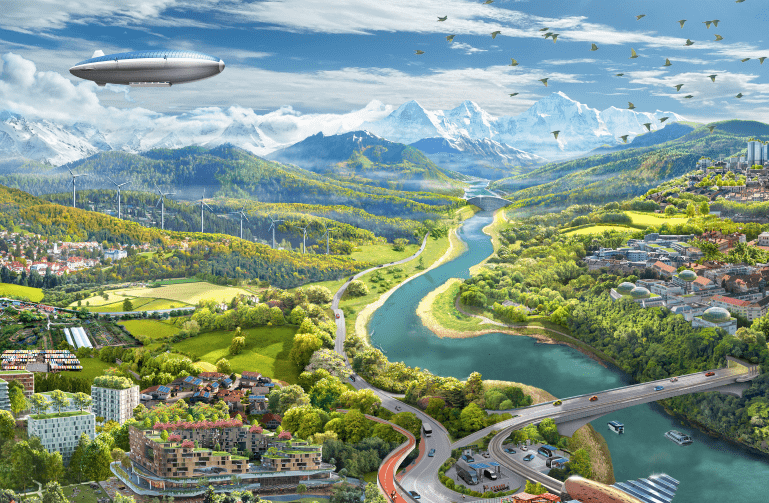
Meaningful behavioural change will only happen if a sustainable, resilient future feels tangible – and brands have an important role to play
As the planet hurtles towards 1.5C, public buy-in to sustainable activities is absolutely vital to meet net zero targets and reduce the impact of carbon emissions.
In polling and focus groups carried out by Public First, it is clear that the British public are really worried about the climate crisis, think they should be doing more to help, and understand the nuts and bolts of what that entails: less red meat, more green energy, flying less, reducing waste, buying sustainable items, and taking public transport. But they do not seem to feel motivated to take action. For those working in this space, there can be a sense of disbelief in this disconnect. If people recognise the threat of climate change, why will they not act?
However, it is actually a very rational response.
Try to imagine yourself going about your ordinary life in 2060. Assume all our climate mitigation and adaptation plans have gone well, try to imagine this future for yourself in as much richness of detail as possible: the daily routine, commute, food, clothing, your bedroom and streetscape.
–
I don’t know about you, but I struggle to imagine a very detailed life for myself in this climate utopia. It is a foggy and far away concept. If this was the case for you too, then you are not alone. Focus groups we ran last year to understand the barriers stopping British people from giving up their cars showed a similar disconnect between our current car and carbon reliant society, and the future ‘idea’ of a low carbon society. One problem was that sustainable behaviours in the short term were neither appealing, exciting or empowering (particularly in our current context of rail strikes and cancellations). Another issue is the long term vision of a low carbon society seemed abstract and far-off, akin to science fiction.
How can we expect people to make drastic and often inconvenient changes to their lifestyle in the name of a future they cannot imagine? It’s a big ask, like dangling a carrot really far away. And you’re not really sure it’s a carrot after all.
If we want consumers to adopt sustainable behaviours then we need them to understand and feel positive about what their lives will look like in a low carbon future. Brands have an important role to play in painting this picture.
Whilst there has been a proliferation in brands creatively showing the scale and urgency of the climate crisis (this twitter thread is full of great examples), very few imagine what a low carbon society may look like day-to-day. Politicians have only delivered high-level soundbites (“our cars will be electric gliding around our cities, our planes will be zero-emission..”) and incredibly dry and impersonal policy documents. We are in desperate need of narratives that make a sustainable future sound alluring, hopeful and most of all – attainable. As Nigel Topping writes:
“Before we can build the resilient zero carbon economy that we have promised future generations, we must first imagine it and not just in a vague happy ‘won’t it be lovely when we get there’ imagination, but a complex, rich, detailed imagining of new ways of doing and being, of new institutions, new laws, new societal goals.”
Businesses can and should find imaginative and striking new ways to help the public imagine themselves living in – and benefiting from – a sustainable future.
There are several already leading the charge:
- Petit Pli have brilliant comms firmly positioning them as the future of fashion – see their ‘mars test’ graphic for how they make slow fashion seem fun and achievable.
- Solitaire Townsend describes how comms professionals need to harness the power of glamour, silliness and fun when talking about their sustainable products. I think Octopus Energy is a great example of comms that makes a bland and often technical topic fun and accessible – take a look at the language in their recent football collab.
- No More Fairytales, shows the power of fiction in showing positive visions of what it may be like to live in a sustainable society. Each short story takes a different perspective, geography and genre. It is wonderful and thought provoking.
- The art world is already on the case, although it often tends towards sci-fi-esque descriptions rather than relatable examples we can apply to our own futures. See the recent V&A event The Future Starts Here which shows how design may shape the near future, and watch this space as the Climate Heritage Network has launched a program which asks: ‘what might a well-adapted society look like?’
- Not a brand but a great example – the Swiss government produced a series of interviews with people living in 2050 according to their net-zero strategy. Characters include Mia, who lives car-free in Zurich, and Stefan, a former intensive livestock farmer. A brilliant way to bring to life technical policy.
- Netflix will be showcasing General Motors electric vehicles in their shows. The streaming giant wants to “build an EV culture” by showing what it’s like to drive and own an EV – I hope this will include second hand options and car leasing too.
Good examples should be localised and multiple. The public need as many opportunities to find a narrative that they personally relate to. And any brand that helps to imagine this future will not just be helping to provide the rich detail and tangibility we need to prompt critical behaviour change – it will also position the brands as an integral part of the sustainable future which is undoubtedly our direction of travel – whilst also happily helping to save the world.